
Jan2026
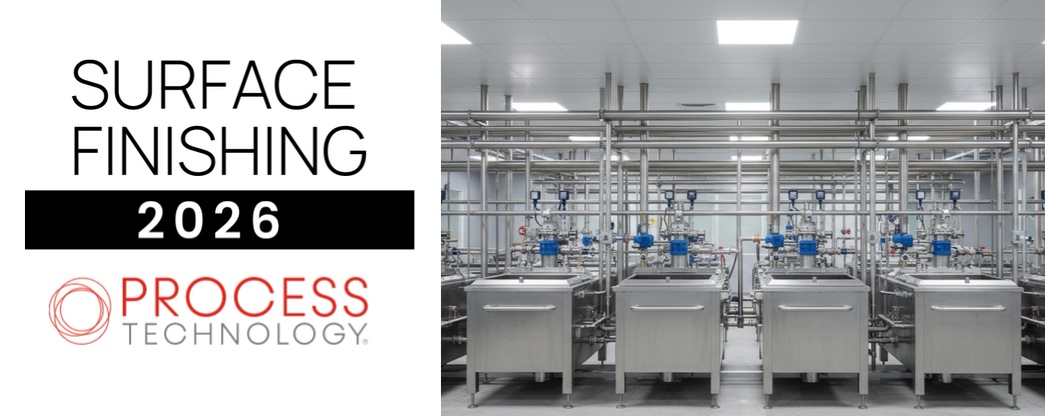
Surface finishing in 2026 continues to advance toward tighter process control, greater repeatability, and long-term reliability. While core processes such as electroplating, anodizing, and advanced coatings remain fundamental, manufacturers are increasingly focused on how those processes are supported at the system level.
For decades, Process Technology has operated at the intersection of surface finishing, thermal control, and power delivery—areas where small variations can have outsized effects on results. From this vantage point, surface finishing is understood not as a single operation, but as a sequence of tightly linked conditions. Surface quality is influenced by temperature stability, electrical consistency, material compatibility, and how well these elements are maintained over time. As production demands increase across industries—from traditional metal finishing to semiconductor manufacturing—the ability to hold stable process conditions has become just as important as the chemistry itself.
From an engineering standpoint, surface finishing processes are highly sensitive to variability. Small fluctuations in temperature or electrical input can introduce inconsistency in coating behavior, surface uniformity, and overall yield. Over time, this variability leads to rework, downtime, and loss of confidence in the process.
Process Technology’s long-standing role in surface finishing infrastructure provides a clear view into how and why these issues arise. By focusing on heating and power delivery as integral process variables—not secondary utilities—PT supports manufacturers in reducing unnecessary process drift. This systems-based approach reflects a depth of experience with real-world operating environments, where reliability is achieved through stability rather than constant adjustment.
Looking ahead, successful surface finishing operations are defined by the strength of their underlying infrastructure. In 2026, manufacturers are prioritizing equipment and systems designed for repeatability, safety, and lifecycle reliability. Inline thermal control, stable DC power delivery, and application-driven system design all contribute to processes that perform predictably over time.
Process Technology’s leadership in this niche is built on sustained focus: designing thermal and power solutions specifically for demanding surface finishing and high-purity applications. That focus has shaped an engineering-first mindset—one that emphasizes process stability, system integration, and long-term performance rather than short-term optimization. As surface finishing requirements continue to evolve, this disciplined approach remains central to delivering consistent, trustworthy results.